



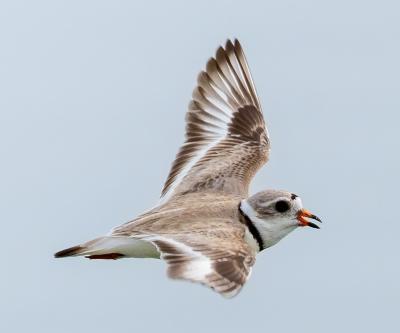
The U.S. Fish and Wildlife Service announced results from the Great Lakes piping plover nesting season, marking 2026 as the most successful year since the population was first listed as endangered in 1986. Notable results include:
- 99 piping plover pairs nested in the region this year, up from 88 pairs in 2025
- 160 wild chicks and 24 captive-reared chicks fledged, bringing the total to a record-breaking 184 fully-fledged piping plover chicks
- 13 zoos participated in the captive rearing program
- Piping plovers nested on all five Great Lakes, an ongoing trend since 2017
This year’s milestones continued an upward trend thanks to decades of recovery efforts, a dedicated community of conservationists, and a bit of luck. Additionally, piping plover conservation efforts have been supported by more than 15 years of Great Lakes Restoration Initiative funding, a collaborative effort led by the Environmental Protection Agency with 16 federal agencies, including the U.S. Fish and Wildlife Service.
Local communities and volunteers continue to play a vital role, contributing their personal time to monitoring, outreach and education. Piping plovers have become a beloved emblem of Great Lakes pride. Public engagement continues to grow, with surveys showing strong support for conservation measures and awareness of the plover’s protected status.
Effective strategies like captive rearing, nest monitoring and habitat restoration have been consistently employed thanks to support from a network of partners. More than a dozen zoos participated in captive rearing, resulting in 24 fully fledged chicks that, otherwise, would not have survived.
Results from habitat research continue to confirm the importance of dynamic, sparsely vegetated shorelines and, at the same time, convey the impact of winter conditions on breeding success. In 2026, the plovers continued to expand their use of habitat including a couple sites that have not been occupied since before the species was listed.
With the recovery goal of 150 nesting pairs in sight, partners remain hopeful. As the season ends and the birds fly south to their wintering grounds, the Great Lakes piping plover stands as a symbol of what’s possible thanks to a shared dedication to endangered species recovery.
Thank you to the long-term partners that have contributed to species recovery, including the following:
Akron Zoo, Army Corps of Engineers, Audubon Great Lakes, Ausable Valley Audubon, Binder Park Zoo, Birds Canada, Black Swamp Bird Observatory, Canadian Wildlife Service and Ontario Ministry of Natural Resources and Forestry, Central Michigan University, Chicago Bird Alliance, Chicago Park District, Chicago Piping Plovers volunteer monitors, Cincinnati Zoo, Cleveland Zoo, Columbus Zoo, Detroit Zoo, Environmental Protection Agency, Great Lakes Tribes, Huron Pines, Illinois Department of Natural Resources, Lake County Audubon, Lake Superior State University, Lincoln Park Zoo, Michigan Audubon, Michigan Department of Natural Resources, National Park Service, National Zoo, New York State Department of Environmental Conservation, NRG Energy, Ohio Department of Natural Resources, Pennsylvania Game Commission, Pennsylvania Department of Conservation and Natural Resources, Potter Park Zoo, Rosamond Gifford Zoo, Saginaw Zoo, St. Louis River Alliance Audubon Society, State University of New York Natural Resources ESF, The Nature Conservancy, Toledo Zoo, Tracy Aviary, University of Michigan Biological Station, University of Minnesota, UP Land Conservancy, US Forest Service, USDA Wildlife Services, Virginia Zoo, Wisconsin Department of Natural Resources, and all of the many volunteers throughout the Great Lakes.
Read the press release on USFWS’ website: Record-breaking season for endangered Great Lakes piping plovers