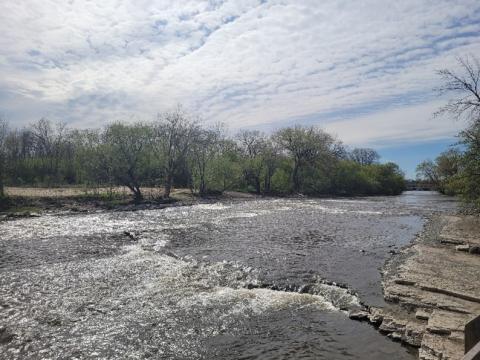
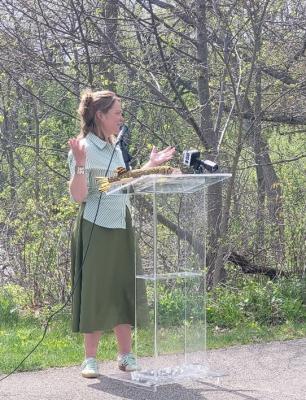
On Tuesday, May 5, EPA joined representatives from the Wisconsin DNR, Milwaukee Metropolitan Sewer District, Milwaukee County Parks, as well as other local and state partners, to celebrate the recently completed Estabrook Falls Fish Passage Project.
Estabrook Falls once blocked many native fish from moving upstream on the Milwaukee River. The falls were a man-made waterfall created from bedrock mining during the late 1800s and early 1900s. However, many native species of fish are unable to move upstream beyond most man-made barriers. This prevented species such as northern pike and lake sturgeon from reaching their critical spawning and nursery habitat in the upper reaches of the river.
To restore fish passage, project partners modified the waterfall to allow fish to ascend the west side channel during lower flows (when the falls are a barrier) and ascend the east side channel during higher flows. The project design preserved the falls features and was completed in the winter of 2025 through a $1.5M Great Lakes Restoration Initiative grant.
“Through the Great Lakes Restoration Initiative, EPA is proud to work with local and state partners to remove barriers and reconnect vital habitat on the Milwaukee River,” said U.S. Environmental Protection Agency Region 5 Administrator Anne Vogel. “The Estabrook Falls project shows how collaboration can revive native fish populations and strengthen the ecological health of the region.”
The project has already made a major impact for native species. In April 2026, for the first time in over 100 years, several Lake Sturgeon made their way upstream to Ozaukee County.
To learn more, visit the project page on MMSD’s website.